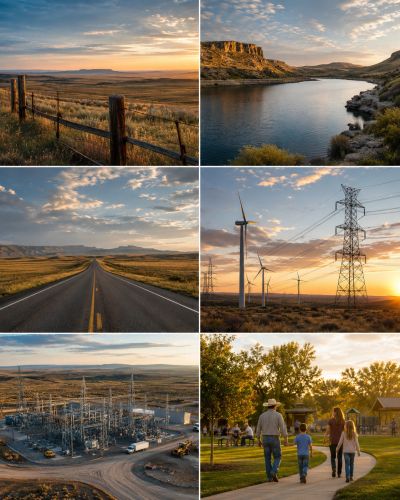
Industrialization – the Future of Converse County?
Converse County stands at a crossroads. Large industrial proposals—renewable energy, transmission, data centers, and possible nuclear development—may bring investment, revenue, jobs, and diversification. Those benefits deserve serious review, not automatic acceptance. In a county defined by ranching, working landscapes, limited water, and close-knit communities, industrial growth can also strain land, power, roads, emergency services, housing, wildlife habitat, and rural quality of life. The argument is not that industrialization should be rejected outright, but that it must meet a higher standard: transparent review, enforceable protections, and clear proof that long-term local benefits exceed public costs. County commissioners should lead that process proactively—asking hard questions early, requiring complete information before commitments are made, and ensuring the public is consulted before irreversible decisions are reached.
Benefits Promoted by Developers
Developers, lobbyists, and some officials present industrial expansion as a strategic opportunity. Large facilities may signal confidence, attract related activity, and strengthen the county’s energy and infrastructure profile. Recent proposals promise capital investment, business recruitment, and long-term tax revenue, but the scale and durability of those benefits remain unproven.
Promoters also emphasize jobs and diversification. New facilities may reduce dependence on legacy industry extraction cycles, create construction and operating jobs, and support local vendors. A diversified industrial base could improve resilience if it produces stable taxable operations, durable local jobs, and measurable benefits for county residents.
Negative Aspects and Structural Risks
Fiscal and Workforce Impacts
Industrial projects are often sold on future tax revenue, but actual county benefit may be narrower than promotional claims. State law can limit local revenue through sales-tax deferrals, manufacturing related sales tax breaks, generation-tax deferrals, and valuation-based distribution. Industrial activity can increase road wear, infrastructure costs, and service demands. The real question is not whether a project generates revenue in the abstract, but whether net revenue meaningfully exceeds the public costs it creates. Commissioners should require realistic fiscal-impact modeling, verified assumptions, and binding cost-recovery mechanisms before relying on investment totals or broad economic-development rhetoric.
Job claims deserve scrutiny. Large projects generally create temporary construction work, but that is not the same as lasting local employment. Capital-intensive facilities may employ few permanent local workers, while hiring surges can strain existing employers, housing, schools, and public services. Commissioners should distinguish construction jobs from permanent positions, local hires from imported labor, and projected payroll from actual resident benefit.
Large industrial projects can impose costs on neighboring landowners through noise, vibration, visual intrusion, heat, emissions, traffic, lighting, and loss of rural character. Property value depends on quality of life and the usefulness of land for residential, agricultural, and recreational purposes. When a facility changes how an area looks, sounds, or functions, nearby owners may bear losses while gains flow elsewhere. County policy should anticipate those conflicts through setbacks, screening, traffic controls, notice requirements, and enforceable mitigation rather than treating landowner impacts as incidental.
Industrialization at scale can impose lasting costs on wildlife and natural resources. Large sites, roads, transmission corridors, pipelines, traffic, noise, lighting, emissions, and intensive water use can fragment habitat, disrupt migration and breeding, and alter land and water use. These effects compound when projects concentrate in one area. Converse County should coordinate early with state agencies responsible for wildlife, water, air quality, and land stewardship, and commissioners should insist on rigorous public review of major proposals affecting county resources.
Large-scale industrial development can burden people, livestock, and wildlife where noise, traffic, lighting, emissions, groundwater withdrawals, and land disturbance concentrate. For residents, dust and emissions can worsen air quality, while noise and lighting can disrupt sleep and quality of life. For families using private wells, both water quantity and contamination risk matter, and county review should require baseline information, monitoring, and a clear response plan if impacts occur.
Livestock and wildlife face risks from dust, runoff, reduced water availability and quality, chronic disturbance, habitat fragmentation, and disrupted access to grazing or water. These impacts threaten both the environment and long-term agricultural viability.
Because Converse County has a limited labor pool, industrial expansion can displace as well as create activity. Large projects may pull workers from existing employers or require in-migration, straining housing, roads, and services. Historivally transient workers spend much of their income elsewhere, local benefits shrink while disruption remains. This is known as economic leakage.
If permanent employment is small, the county may face boom-time disruption with limited long-term gain. Commissioners should ask who will fill the jobs, where workers will live and spend money, what existing employers may lose, and whether residents will see a net improvement.
Resource and Infrastructure Demands
Water demand is a serious concern in a semi-arid region. Recent proposals have ranged from modest to highly water-intensive, but the key issue is whether total demand is sustainable. Debate over hydrogen-refinery and data-center proposals has raised concerns about groundwater limits, competing uses, drought risk, and long-term uncertainty. Where water supports ranching, homes, municipal supply, and land value, commissioners should require early disclosure of water sources, drought contingencies, and cumulative impacts before projects advance.
Power demand raises similar concerns. Some projects would require enormous generating capacity, including self-generation from natural gas or renewables. While marketed as economic strength, that scale raises questions about emissions, fuel supply, transmission, reliability, and whether extraordinary energy use is justified by relatively few permanent jobs. County leaders should press applicants to explain power sources, grid impacts, emissions implications, and emergency contingencies before granting local support.
Policy Position and Recommendations
Converse County should adopt a strict net-benefit standard, not a growth-at-any-cost model. Commissioners should make that standard proactive rather than reactive by setting expectations before applications are far advanced, requiring independent analysis, and identifying public costs early. No major industrial project should be approved unless the evidence shows that long-term county benefits exceed demands on water, power, roads, emergency response, housing, wildlife habitat, working lands, and other public resources. Fiscal and infrastructure analysis should account for exemptions, service costs, road maintenance, emergency burdens, and economic leakage. Job claims should separate construction work, permanent jobs, local hires, and imported labor. Where evidence is incomplete, conflicting, or applicant-driven, the county should pause and analyze more before approving irreversible changes.
That standard should be enforced through clear approval conditions. The county should require siting that reduces conflicts with ranching, groundwater-dependent agriculture, wildlife movement, and established residences. Applicants should mitigate road damage, housing pressure, water use, property impacts, and harm to wildlife or natural resources before approval, while disclosing water sources, drought plans, power needs, and workforce housing plans. Where state permitting controls key issues, commissioners should insist on full public review of cumulative impacts and long-term public costs.
County policy should treat agriculture and rural land stewardship as assets to protect. Industrial development should fit the county’s character, not the reverse. That means protecting working lands and water supplies, requiring setbacks and controls where landowners bear disproportionate burdens, and monitoring performance over time. Commissioners should require public reporting on employment, tax contribution, resource use, local purchasing, and mitigation compliance, with authority to recover costs or impose corrective conditions if commitments are not met. Industrial development should be welcomed when it is transparent, enforceable, and clearly beneficial to county residents.
Taken together, these risks point to a clear policy principle: major industrial development should be reviewed through a net-benefit standard that measures public costs as carefully as promised gains.
The County’s Complexion: Agricultural Identity and Industrial Growth
As industrialization proceeds, the central question is not whether Converse County will become more industrial; it already has. The question is what kind of place it intends to become. The county’s identity was built on ranching, open land, water-dependent agriculture, and multigenerational stewardship. Industrialization does not occur on a blank slate: when water, roads, labor, and land shift toward large facilities, ranchers, landowners, and rural communities feel the effects directly. Commissioners can shape that future by setting clear expectations now rather than waiting for conflicts to define county policy.
Converse County need not choose between agricultural roots and all industrial development, but coexistence is not automatic. It requires careful siting, controlled water use, mitigation of road and housing impacts, and protection for neighboring landowners. Without those limits, industrial growth is more likely to displace than coexist. The policy choice is whether industrialization will fit the county’s character, or whether the county’s character will yield to it.
A Commissioner’s Proactive Response to Major Development
When a community-altering project is announced, I will not wait for a formal application before beginning my own review. The announcement itself should trigger a proactive response: identifying likely impacts, gathering available information, and asking early questions about water, power, roads, housing, emergency services, jobs, landowner impacts, wildlife, and long-term public costs. Early evaluation does not prejudge the project; it simply ensures the county is prepared before momentum builds, money is spent and key decisions become harder to influence.
I will also engage the public early, especially nearby landowners, municipalities, special districts, emergency responders, and residents likely to experience direct effects. Public meetings, written comment opportunities, and clear information-sharing should begin before the county is asked to approve or endorse anything. Residents should not first learn the details of a major proposal when an application is already moving through the process.
At the same time, I will coordinate with state agencies and other local governments that may have permitting authority or relevant expertise, including agencies responsible for water, wildlife, air quality, transportation, emergency response, and land use. County commissioners do not need to duplicate every state review, but they should make sure county-specific concerns are identified, documented, and communicated early enough to matter.
Finally, I will open a dialogue with the developer about the county’s preliminary concerns and expectations before an application is filed. Those expectations should include complete disclosure of resource demands, realistic fiscal and workforce projections, mitigation commitments, public engagement requirements, and a willingness to adjust the project to protect the county’s long-term interests. There is no reason for commissioners to remain passive until paperwork is submitted. Responsible leadership means evaluating early, engaging openly, coordinating broadly, and making clear that any community-altering project must earn public confidence before it earns county support.
Conclusion
Industrialization in Converse County should be judged by one standard: whether it leaves the county measurably better off after all costs and benefits are counted accurately and honestly. That is not anti-development; it is responsible governance. If industrial development cannot show clear net local benefit, protect agriculture and rural character, and accept enforceable mitigation and accountability, then it is not the right kind of development for Converse County.